

OpenAI has released GPT-6 Astra, a new frontier model with a strong focus on computer use: working directly inside software, understanding what is happening on screen, and completing multi-step tasks in professional applications. Game development was one of the areas featured in the demonstrations.
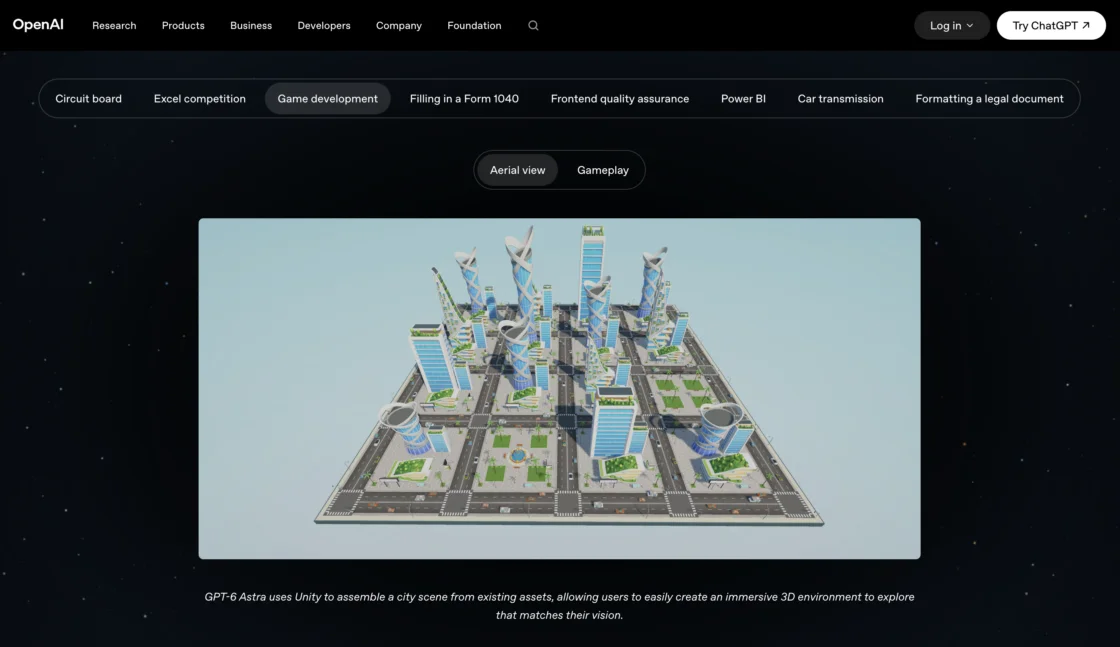
In one of them, GPT-6 Astra used our free Cartoon City Free pack inside Unity. The model assembles a city from existing assets and creates an environment that can be explored at street level. A quote from the presentation:
GPT-6 Astra uses Unity to assemble a city scene from existing assets, allowing users to easily create immersive 3D environments for exploration that match their vision.
Our view of AI in 3D is fairly practical. Generative models can already create things that look impressive in a polished turntable render, but that is far from the hardest part.
What matters much more is whether an asset works properly in a real project alongside hundreds of others: clean and editable topology, proper UV mapping, reusable materials, correct scale and pivots, and a sensible polygon count.
That is why what interested us most about OpenAI’s demonstration was that the model was not trying to generate new assets. Instead, it was working with an existing, prepared library and focusing on composition – placing roads, buildings, and other scene elements.
This is where we see a genuinely interesting application of AI.
Most of our environment packs include a demo scene, but the scene itself is only an example of what can be built from the buildings, roads, vegetation, props, and characters included in the pack. The real value lies in these building blocks and the ability to use them to create your own locations.
Until now, arranging those elements has largely been the work of a level designer. In the future, AI could take over part of that process: describe the location you need, let an agent assemble a first version from an existing asset library, and then refine the result manually. Or ask it to create several variations of the same city block and choose the one that works best.
For a 3D studio like ours, the development of generative AI obviously cannot be viewed only with enthusiasm. If models become capable of consistently producing genuinely high-quality, production-ready assets, they will directly compete with what we do.
But the scenario demonstrated by OpenAI looks different. If AI can help us create more interesting demo scenes faster, while helping game developers turn high-quality existing assets into complete levels and locations, then it is not replacing our work. It is becoming a new tool built on top of it.
That is the direction we find genuinely useful.
